Capital Gains Tax in India 2025: STCG vs LTCG, Property, Equity

Capital gains tax in India changed significantly with the Union Budget 2024. The Income Tax Act, 2025 codifies these changes — new STCG rate of 20%, LTCG at 12.5%, removal of indexation for property sales, and ₹1.25 lakh exemption on equity LTCG. This guide covers all asset classes with worked examples.
Types of capital gains

Whether a capital gain is short-term or long-term depends on the holding period — how long you owned the asset before selling it. The key threshold for most assets is 24 months, but equity and equity mutual funds have a lower threshold.
| Asset Class | Short-Term (STCG) | Long-Term (LTCG) | STCG Rate | LTCG Rate |
|---|---|---|---|---|
| Listed equity shares | < 12 months | ≥ 12 months | 20% (Sec 111A) | 12.5% above ₹1.25L (Sec 112A) |
| Equity mutual funds (ELSS, Index, etc.) | < 12 months | ≥ 12 months | 20% | 12.5% above ₹1.25L |
| Debt mutual funds (post Apr 2023) | Any holding period | N/A (no LTCG) | Slab rate | Slab rate |
| Immovable property (land/building) | < 24 months | ≥ 24 months | Slab rate | 12.5% (no indexation from Jul 2024) |
| Gold / physical gold | < 24 months | ≥ 24 months | Slab rate | 12.5% |
| Sovereign Gold Bonds (SGB) | < 12 months | ≥ 12 months | Slab rate | 12.5% |
| Debt bonds / NCDs | < 24 months | ≥ 24 months | Slab rate | 12.5% |
| Unlisted shares | < 24 months | ≥ 24 months | Slab rate | 12.5% |
LTCG on equity: the ₹1.25 lakh exemption
Long-term capital gains on listed equity shares and equity mutual funds above ₹1.25 lakh per year are taxed at 12.5% with no indexation benefit (Section 112A, retained with same number in the 2025 Act). Key points:
- Gains up to ₹1,25,000 in a financial year: zero tax
- Gains above ₹1,25,000: 12.5% on the excess only
- No benefit of basic exemption limit against LTCG (except for senior citizens)
- Securities Transaction Tax (STT) must have been paid on both purchase and sale
Example: You sell equity shares in December 2025 with a long-term gain of ₹3,00,000.
Exempt: ₹1,25,000. Taxable gain: ₹1,75,000. Tax: ₹1,75,000 × 12.5% = ₹21,875 (+ 4% cess = ₹22,750).
Capital gains on property: indexation removed
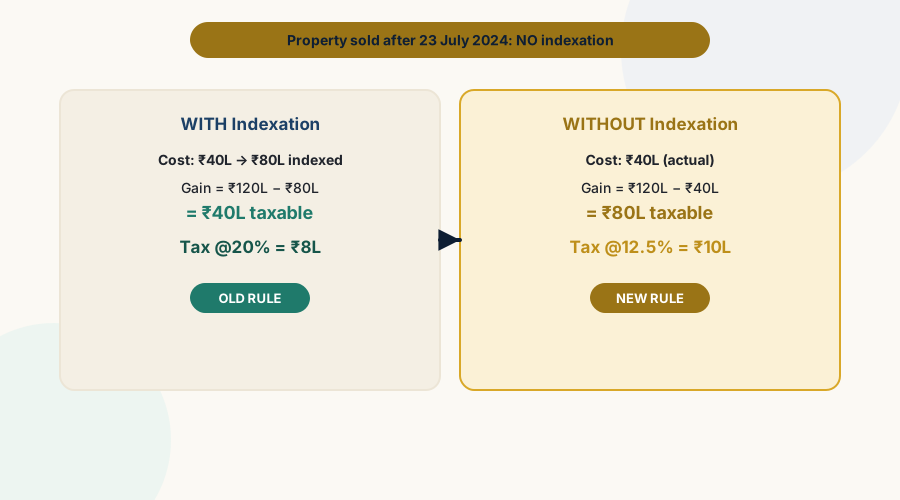
One of the most significant changes in Budget 2024 (now codified in the Income Tax Act, 2025) is the removal of the indexation benefit for property sold after 23 July 2024:
| Scenario | Before 23 July 2024 | From 23 July 2024 |
|---|---|---|
| Purchase price | ₹40 lakh (2010) | ₹40 lakh (2010) |
| Sale price | ₹1.2 crore (2025) | ₹1.2 crore (2025) |
| Indexed cost (CII-adjusted) | ~₹80 lakh | Not available |
| Capital gain | ₹40 lakh (indexed) | ₹80 lakh (actual) |
| Tax rate | 20% with indexation | 12.5% without indexation |
| Tax payable | ₹8 lakh | ₹10 lakh |
In this example, the removal of indexation results in ₹2 lakh more tax. However, for properties where the CII adjustment would have been minimal, the lower 12.5% rate could be beneficial. The impact is property and acquisition-year specific.
For property acquired before 1 April 2001, the cost is taken as the Fair Market Value (FMV) as of 1 April 2001. For properties sold on or before 22 July 2024, the old rules with indexation continue to apply.
Set-off and carry forward of capital losses
| Loss Type | Can be set off against | Carry forward period |
|---|---|---|
| Short-term capital loss | Any capital gain (STCG or LTCG) | 8 years |
| Long-term capital loss | Long-term capital gains only | 8 years |
| Any capital loss | Cannot be set off against other income heads | — |
Important: Capital losses can only be carried forward if your ITR is filed before the due date. Late filers lose this benefit.
How to save capital gains tax legally
- Section 54 (property reinvestment) — Invest LTCG from residential property into another residential property within 2 years (or construct within 3 years) to claim exemption. Available under Section 54 in both 1961 and 2025 Acts.
- Section 54EC — Invest LTCG up to ₹50 lakh in notified bonds (NHAI, REC) within 6 months of sale. Lock-in period: 5 years.
- Section 54F — Invest net sale consideration (not just gain) from any long-term asset (not property) into residential property.
- Tax loss harvesting — Sell equity positions at a loss to offset gains. Can be done systematically in March each year. Repurchase after 30 days if needed.
- LTCG harvesting (₹1.25L annually) — Book up to ₹1.25 lakh of equity LTCG every year tax-free. Reinvest in same fund to reset cost basis higher.
Track and manage your investment portfolio
Investment Portfolio Tracker Notebook
Dedicated investment journal to track purchase price, holding period, and capital gain/loss on shares, MFs, and property.
View on Amazon →Tax Guide for Investors India
Comprehensive reference on capital gains tax, dividend tax, and ELSS for Indian retail investors.
View on Amazon →Fireproof Document Bag — Share Certificates
Store original share certificates, mutual fund account statements, and property deeds securely.
View on Amazon →ℹ Disclosure: IncomeTaxAct.com is a participant in the Amazon Services LLC Associates Program. We earn a commission at no extra cost to you when you purchase through our links. Read our full affiliate disclosure.
Long-term capital gains (LTCG) on listed equity shares and equity mutual funds held for more than 12 months are taxed at 12.5% for gains above ₹1.25 lakh per financial year. Gains up to ₹1.25 lakh are fully exempt under Section 112A of the Income Tax Act, 2025 (same as 1961 Act).
No. For properties sold after 23 July 2024, indexation is not available. Long-term capital gains (holding period ≥ 24 months) on property are taxed at a flat 12.5% on the actual gain (sale price minus cost of acquisition) without any Cost Inflation Index adjustment. This change was introduced in Budget 2024 and is now codified in the Income Tax Act, 2025.
Short-term capital gains on equity mutual funds held for less than 12 months are taxed at 20% under Section 111A of the Income Tax Act, 2025 (up from 15% before Budget 2024). For debt mutual funds (post April 2023 purchases), gains are taxed at slab rates regardless of holding period — there is no LTCG treatment for debt funds under current law.
Related Guides