Income Tax for Freelancers & Self-Employed in India 2025: Complete Guide
India has over 15 million freelancers and self-employed professionals — and many of them overpay tax or face penalties simply from not knowing the rules. The Income Tax Act, 2025 simplifies presumptive taxation and extends deadlines for this group. This complete guide covers everything from choosing ITR form to paying zero tax legally.
Presumptive taxation: the simplest route for freelancers
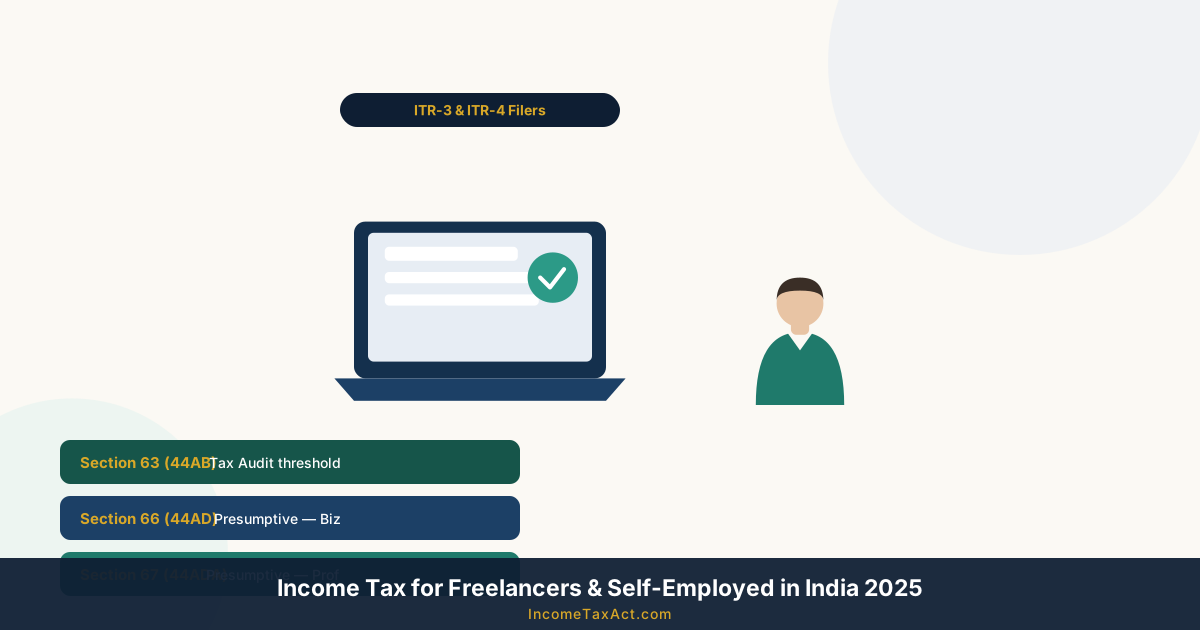
The presumptive taxation scheme (now Sections 66 and 67 of the 2025 Act, old Sections 44AD and 44ADA) allows eligible freelancers and small business owners to compute income on a presumptive basis — no books of accounts required, no audit, simplified ITR-4 filing.
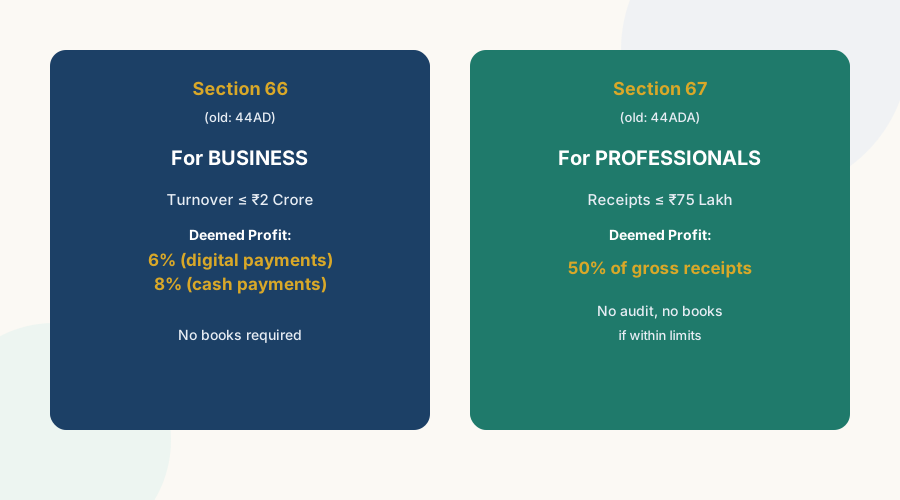
Section 66 (old 44AD): Presumptive for Business
| Condition | Detail |
|---|---|
| Eligible taxpayers | Individuals, HUFs, partnerships (non-LLP) with business income |
| Turnover limit | Up to ₹2 crore per year |
| Deemed profit rate — digital | 6% of gross receipts (digital payments, cheque, banking) |
| Deemed profit rate — cash | 8% of gross receipts (cash payments) |
| Books of account required | No |
| Tax audit required | No (if declaring ≥ 6%/8% of turnover) |
| Advance tax | One installment by 15 March (not quarterly) |
Example: A freelance web developer with ₹18 lakh annual revenue (all bank transfers) declares 6% = ₹1,08,000 as income. Under the new regime, after ₹75,000 standard deduction (not available for business income), taxable income ≈ ₹1,08,000 — below the basic exemption limit. Zero tax payable.
Section 67 (old 44ADA): Presumptive for Professionals
| Condition | Detail |
|---|---|
| Eligible professions | Doctors, lawyers, engineers, architects, accountants, consultants, interior designers |
| Gross receipts limit | Up to ₹75 lakh per year (increased from ₹50L) |
| Deemed profit rate | 50% of gross receipts |
| Books of account required | No |
| Advance tax | One installment by 15 March |
Example: A freelance graphic designer earns ₹12 lakh. Under Section 67, deemed income = 50% × ₹12L = ₹6,00,000. New regime tax on ₹6L: ₹10,000 (5% on ₹4L–6L) + 4% cess = ₹10,400. Much lower than if actual expenses are not maintained.
If you opt for presumptive taxation under Section 66 (business), you must continue for at least 5 consecutive years. If you opt out before 5 years, you cannot use the scheme for 5 more years, and you'll need to maintain full books and potentially undergo a tax audit for all 5 years.
Advance tax: the quarterly payment obligation
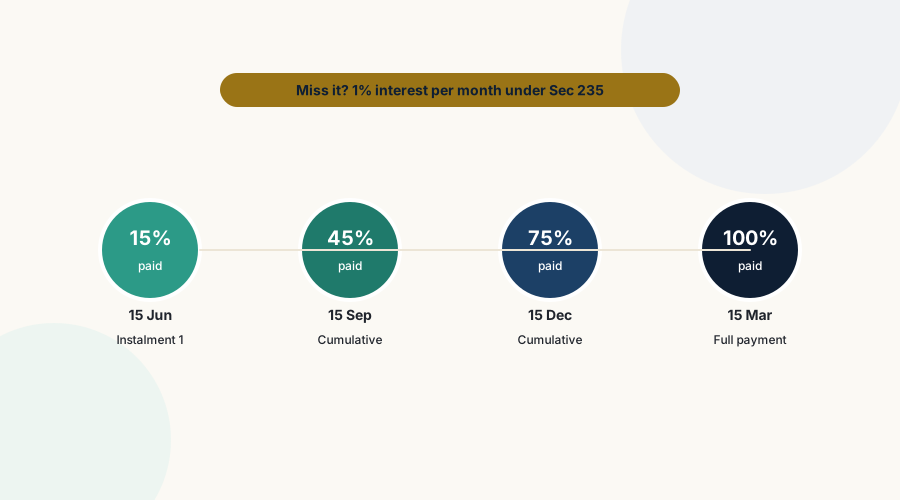
If you are not under the presumptive scheme, advance tax must be paid quarterly if your net tax liability exceeds ₹10,000 for the year:
| Instalment | Due Date | Cumulative % of tax to be paid |
|---|---|---|
| 1st instalment | 15 June 2025 | 15% |
| 2nd instalment | 15 September 2025 | 45% |
| 3rd instalment | 15 December 2025 | 75% |
| 4th instalment | 15 March 2026 | 100% |
Under presumptive schemes (Sections 66/67), the entire advance tax is due in a single payment by 15 March.
Penalty for non-payment: Interest at 1% per month under Section 235 (old 234B) for shortfall, and 1% per month under Section 236 (old 234C) for deferment.
Which ITR form do freelancers use?
- ITR-4 (Sugam) — if income is under the presumptive scheme (Sec 66 or 67) and meets all eligibility conditions. Simplest form to file.
- ITR-3 — if you maintain books of account, have income above presumptive limits, or want to declare actual expenses rather than the deemed percentage. More complex.
Allowable deductions for self-employed (actual expense method)
If you choose to maintain books and file ITR-3 (not using presumptive scheme), you can deduct all genuine business expenses:
- Internet, phone, and data costs (business proportion)
- Equipment: laptop, camera, software, hardware
- Home office rent or a proportion of home rent
- Professional subscriptions (Adobe CC, GitHub, etc.)
- Travel for client meetings
- Professional development: courses, books, conferences
- Contractor and outsourcing payments
- Bank charges, payment gateway fees
- Health insurance premium (if self-employed, under Section 124/80D)
GST and income tax: both may apply
Income tax and GST are separate obligations. A freelancer earning above ₹20 lakh (services) or ₹40 lakh (goods) in most states must register for GST and collect 18% GST on invoices. GST collected is remitted to the government and does not form part of your income for income tax purposes. However, GST returns must be filed separately from ITR.
Tools for freelancers managing their taxes
Self-Employed Tax Organizer Accordion File
13 pockets for GST invoices, advance tax challans, expense receipts, and client contracts — keep your freelance taxes organised.
View on Amazon →Invoice and Business Receipt Book
Professional carbonless invoice book for issuing receipts to clients — essential for maintaining business records.
View on Amazon →Portable UPS / Battery Backup
Never lose unsaved tax return data during a power cut. Reliable battery backup for your laptop and router.
View on Amazon →ℹ Disclosure: IncomeTaxAct.com is a participant in the Amazon Services LLC Associates Program. We earn a commission at no extra cost to you when you purchase through our links. Read our full affiliate disclosure.
Yes. Freelancers and self-employed individuals whose total income tax liability for the year exceeds ₹10,000 must pay advance tax quarterly (15 June, 15 September, 15 December, 15 March). However, if you opt for presumptive taxation under Section 66 or Section 67, you only need to pay advance tax in one instalment by 15 March. Missing advance tax deadlines attracts interest at 1% per month.
Under Section 67 presumptive taxation (if you are an eligible professional), 50% of ₹10 lakh = ₹5 lakh is the deemed taxable income. Under the new regime, tax on ₹5 lakh: ₹5,000 (5% on ₹4–5L). With 4% cess, total tax = ₹5,200. If using Section 66 (business) with digital receipts, deemed income = 6% of ₹10L = ₹60,000 — below the basic exemption, zero tax.
Yes, but only if you are filing ITR-3 with actual books of account rather than using the presumptive scheme. Under the actual method, all genuine business expenses — laptop, internet, software subscriptions, home office rent, equipment, travel — are deductible from your gross receipts to arrive at net taxable business income. Under the presumptive scheme, no separate expense deductions are allowed since the deemed profit rate already accounts for them.
Related Guides