NRI Tax Guide 2025: How Non-Resident Indians Are Taxed in India
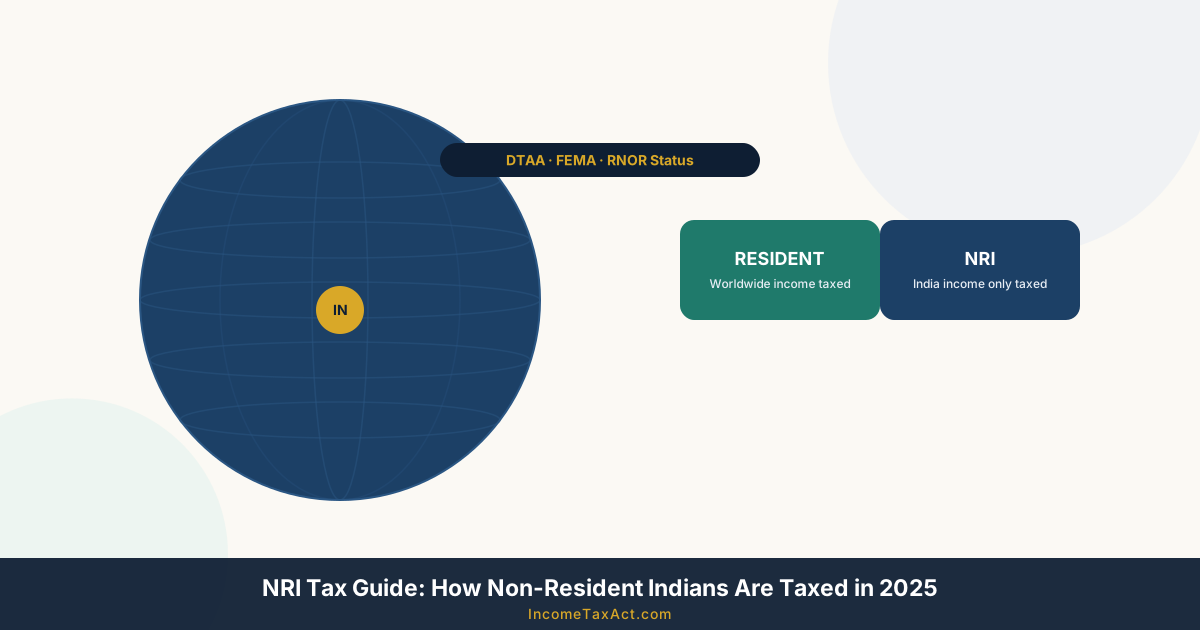
Non-Resident Indians (NRIs) have a specific tax position that depends on their residency status, the source of their income, and any applicable Double Taxation Avoidance Agreement (DTAA). This guide covers everything — from determining if you are an NRI for tax purposes to filing your return from abroad.
Step 1: Determine your tax residency status
Your tax residency under the Income Tax Act, 2025 (Section 6) is determined by the number of days you spend in India during the Tax Year (April–March):

| Status | Condition | Income Taxable in India |
|---|---|---|
| Resident and Ordinarily Resident (ROR) | ≥182 days in India this year, AND has been resident in at least 2 of last 10 years, AND ≥730 days in India in last 7 years | Worldwide income |
| Resident but Not Ordinarily Resident (RNOR) | ≥182 days this year but new returnee (resident < 2 of 10 years), OR ≥60 days but < 730 days in last 7 years | Income received/accrued in India + business/profession controlled from India |
| Non-Resident (NRI) | <182 days in India this year (general rule) or <120 days if Indian citizen abroad with Indian income >₹15L | Only income received or deemed to accrue in India |
From FY 2020-21 onwards, Indian citizens living abroad who have Indian-source income exceeding ₹15 lakh are deemed residents if they spend 120+ days in India (down from 182). This targets cases where individuals become residents of no country (tax haven residency). If you are an Indian citizen living in the UAE or other tax-free countries with Indian income, verify your day count carefully.
What income is taxable in India for NRIs?
As an NRI, only income that is received in India or accrues/arises in India is taxable here:
| Income Type | Taxable in India? |
|---|---|
| Salary for services rendered in India | Yes |
| Salary paid by Indian company for services abroad | Yes (received by Indian employer) |
| Rental income from property in India | Yes |
| Capital gains on Indian securities / property | Yes |
| Interest on NRE (Non-Resident External) bank account | No — fully exempt |
| Interest on NRO (Non-Resident Ordinary) account | Yes — TDS @ 30% |
| Dividend from Indian companies | Yes — TDS @ 20% |
| Income from mutual funds in India | Yes — at applicable rates |
| Foreign salary / business income abroad | No (NRI) |
| Foreign pension / rental income abroad | No (NRI) |
Double Taxation Avoidance Agreement (DTAA)
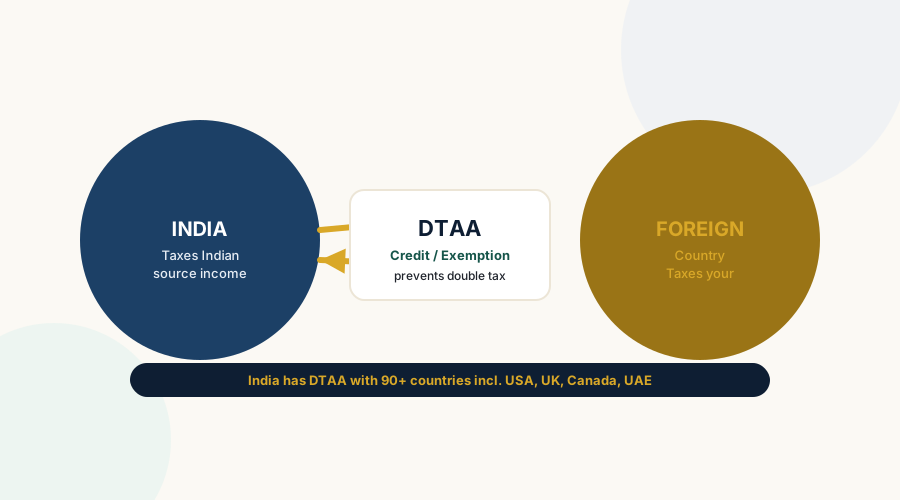
India has DTAAs with over 90 countries. Key countries for the Indian diaspora:
| Country | Key DTAA Benefits for NRIs |
|---|---|
| USA | DTAA signed 1989; taxation of interest, dividends, capital gains negotiated; foreign tax credit available in both countries |
| United Kingdom | Strong DTAA covering salary, pension, business income; UK pension taxable only in UK for UK-resident Indians |
| Canada | DTAA covers all major income types; NROs can claim lower withholding on dividends |
| UAE | DTAA signed; UAE residents (with tax residency certificate) exempt from Indian tax on UAE-source income |
| Australia | DTAA prevents double taxation on salary, dividends, interest; capital gains taxed based on asset location |
| Germany | DTAA signed 1995; special treatment for pensions, business income |
| Singapore | DTAA signed; favourable treatment for capital gains; updated protocol 2005 |
To claim DTAA benefits, you must provide your deductor (e.g., Indian bank, company) with:
- A Tax Residency Certificate (TRC) from your country of residence
- A Form 10F (self-declaration) with your foreign tax identification number
NRI bank accounts: NRE vs NRO vs FCNR
| Account | Currency | Interest taxable in India? | Repatriable? |
|---|---|---|---|
| NRE (Non-Resident External) | INR (converted from foreign) | No — fully exempt | Yes — freely |
| NRO (Non-Resident Ordinary) | INR | Yes — TDS at 30% (or DTAA rate) | Limited (up to $1M/year after tax) |
| FCNR (Foreign Currency Non-Resident) | Foreign currency (USD, GBP, EUR, etc.) | No — fully exempt | Yes — freely |
Do NRIs need to file an ITR in India?
An NRI must file an ITR in India if any of the following apply:
- Total India-sourced income exceeds the basic exemption limit (₹2.5L old regime / ₹3L new regime)
- You have long-term capital gains on Indian securities above ₹1.25L
- Excess TDS was deducted on NRO account interest and you want a refund
- You sold property in India and want to claim exemption (Section 54 reinvestment)
NRIs can file their ITR online at incometax.gov.in using ITR-2 (most NRIs) or ITR-1 (if only salary/one property/other sources, income ≤ ₹50L, and Indian resident classification). Filing deadline is typically 31 July (31 October if tax audit applies).
For NRIs managing their India finances from abroad
International Document Organizer Wallet
Secure organiser for passports, foreign residence permits, Indian PAN card, NRE/NRO account documents, and DTAA certificates.
View on Amazon →Encrypted USB Drive — 256GB
Store encrypted scans of your Indian tax documents, Form 26AS, property papers, and bank statements securely while travelling.
View on Amazon →Fireproof Waterproof Document Bag
Protect your Indian property documents, PAN card, Aadhaar, and Form 16 copies in fireproof, waterproof storage.
View on Amazon →ℹ Disclosure: IncomeTaxAct.com is a participant in the Amazon Services LLC Associates Program. We earn a commission at no extra cost to you when you purchase through our links. Read our full affiliate disclosure.
The general rule under Section 6 of the Income Tax Act, 2025 is that you are treated as a Non-Resident if you spend fewer than 182 days in India during the tax year. However, if you are an Indian citizen or Person of Indian Origin (PIO) with India-sourced income above ₹15 lakh, the threshold reduces to 120 days. Beyond 182 days (or 120 days for high-income Indian citizens), you become resident for that year and your worldwide income may be taxable.
No. Interest earned on Non-Resident External (NRE) savings and fixed deposit accounts is fully exempt from income tax in India as long as you maintain NRI status. However, when you return to India permanently and become a Resident (not RNOR), NRE account interest becomes taxable after 2–3 years (when you lose RNOR status).
Yes. NRIs can invest in Indian mutual funds through their NRE or NRO accounts, subject to FEMA regulations. Gains are taxed in India at the standard rates — equity LTCG at 12.5% above ₹1.25L and STCG at 20%, debt fund gains at slab rates. TDS is deducted by the mutual fund house before redemption. NRIs from the USA and Canada face additional compliance requirements (FATCA) that some fund houses do not accommodate.
Related Guides